
 $169
$169 9 min
9 min2D, 3D, 4D and 5D HD Ultrasound: What Is the Difference?
2D, 3D, 4D and 5D HD ultrasound explained simply: what each one shows, when it is most useful and which Video Prenatal package uses it at your stage.
By the Video Prenatal team · September 6, 2026 · 4 min read

Our ultrasounds are elective, non-diagnostic, and performed solely for keepsake and peace of mind purposes. They are not a substitute for a medical ultrasound from your healthcare provider.
When you start looking at ultrasound options, the letters pile up quickly: 2D, 3D, 4D, 5D, HD. Understanding the difference between 2D, 3D, 4D and 5D ultrasound helps you choose the right visit for your week and know what to expect on the screen.
The good news is that all of them come from the same basic idea. Sound waves travel into your belly, bounce back from your baby and are turned into an image. What changes is how much information is gathered and how it is displayed. Here is a simple, honest breakdown from our team in Charlotte.
2D ultrasound: the classic black and white view
A 2D ultrasound shows a flat slice through your baby, in shades of black, white and gray. It is the image most parents recognize from their first medical appointment. Because it looks at one slice at a time, it is excellent for things that need a clear cross-section: the heartbeat, measurements and the signs of boy or girl.
2D is the right tool early in pregnancy and for gender visits. Our First Peek (Peace of Mind) visit uses 2D from 7 to 40 weeks to let you hear or see the heartbeat, check growth, weeks and due date and take home printed pictures. If you are waiting to find out boy or girl, our week by week article on when you might find out boy or girl explains the timing.
3D ultrasound: still images with depth
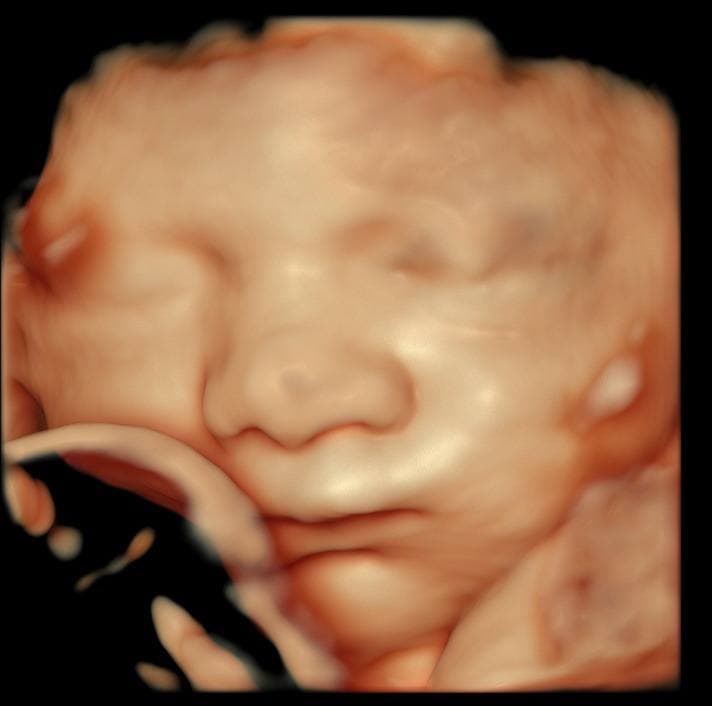
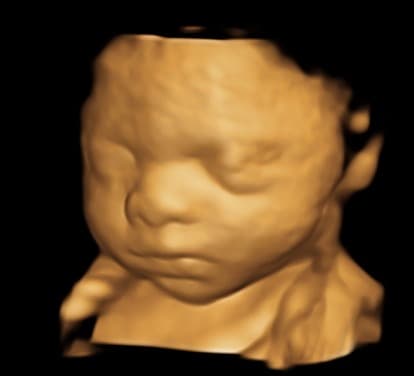
A 3D ultrasound collects many slices at once and assembles them into a three-dimensional picture. Instead of an outline, you see the curve of a cheek, the shape of the nose and the fullness of the lips, usually in a warm, skin-like color.
3D images are still pictures, a bit like a photo. They are wonderful keepsakes because they let you recognize your baby's features, and many parents say they see a family resemblance for the first time. During a Gender Reveal visit (15 to 22 weeks), we may show a short 3D sneak peek if the baby is in a good position, but faces are still small and lean at that stage.
4D ultrasound: 3D in real time
The fourth dimension is time. A 4D ultrasound shows 3D images live, so you watch your baby move as it happens: yawning, sucking a thumb, rubbing an eye or turning away shyly. For many families, this is the moment that makes the visit unforgettable, because it feels like meeting a little personality.
Because 4D follows movement, it is also where your baby's position becomes part of the adventure. Sometimes the best view appears after a stretch or a change in your position. We explain what influences these moments in fluid, placenta and baby's position: what shapes your images.
5D HD ultrasound: more light, more lifelike
5D is not an extra dimension. It is the name widely used for HD rendering, where the software adds a virtual light source, soft shadows and more natural skin tones to 3D and 4D images. The result looks less like a sculpture and more like a portrait.
At Video Prenatal we scan with a GE Voluson E10 and offer HDlive Silhouette, a rendering style that gives images a gentle, translucent quality and helps contours stand out. We are the exclusive provider of HDlive Silhouette in Charlotte and nearby areas. You can read more in HDlive Silhouette: why your baby's images look so real. Remember that HD rendering changes how the scan is displayed, not what the machine can see, so fluid and position still matter.
- 2D: heartbeat, growth, measurements and gender.
- 3D: still images of your baby's features with depth.
- 4D: those same 3D views moving in real time.
- 5D HD: 3D and 4D with realistic lighting and skin tones.
Which one is right for you?
It depends on what you want from the visit. If you want reassurance, the heartbeat or an early look at growth, 2D is ideal. If your priority is gender, a 2D/3D gender visit fits the middle of pregnancy. If you dream of seeing your baby's face and expressions, 5D and HD sessions later in pregnancy give you the most to see.
Whatever you choose, an elective ultrasound is a keepsake and peace of mind experience that never replaces the scans your OB or midwife orders. For the full picture of all these options, see our complete guide to 3D, 4D and 5D HD ultrasound.
Finding the package that matches your stage
Here is how the technologies line up with our packages. First Peek, $59, from 7 to 40 weeks, uses 2D. Gender Reveal, $79, from 15 to 22 weeks, uses 2D/3D. 5D Sneak Peek, $99, from 22+ weeks, introduces 5D. Golden Memories, $129, and Mommy Bundle, $169, both from 27+ weeks, offer the longest 5D/HD sessions.
If you would like help deciding, our article on choosing the right ultrasound package for your week goes deeper, or you can compare our packages and book when it feels right.
Part of our complete guide: The Complete Guide to 3D, 4D and 5D HD Ultrasound
Frequently asked questions
Is 4D ultrasound better than 3D?
Not better, just different. 3D gives you still pictures with depth, and 4D shows those images moving live, so many families enjoy having both in the same session.
Can a 2D ultrasound show my baby's face?
A 2D scan can show your baby's profile in black and white, but it will not show the rounded, skin-toned features you see in 3D or HD.
Does 5D mean a stronger ultrasound?
No. 5D refers to HD rendering, which changes how the image is lit and displayed. It is the same type of scan with a more lifelike presentation.
Which ultrasound do I need for gender?
Gender is usually determined with 2D. Our Gender Reveal package, from 15 to 22 weeks, uses 2D/3D and includes a 3D sneak peek when the baby is in a good position.